Sorting comes before packing, and labeling by destination beats labeling by contents. A crew reads box labels to decide which room each box lands in. The room name is really what earns its place on the box, you know.
We build estimates from the inventory a customer gives us, and a sorted household gives a far more accurate one. Booking professional movers early does not help if the inventory changes twice before the truck arrives. Start with the room you use least and finish it before opening the next door.
Sorting Comes Before Packing, Always
Hiring packing services for a room you have not sorted means paying to move things you were going to get rid of anyway. A city move is priced on how much there is and how long the carry takes. Every box headed for a donation bin costs you twice, once in wrapping and once in carrying. The order matters more than the effort: decide, then pack.
An accurate inventory is what keeps the quoted number stable on the day. Working through the house in a fixed order also stops you finding rooms you forgot about, which happens more than people admit. A garage remembered on moving morning is what turns a six-hour job into a nine-hour one.
Work One Room at a Time, and Finish It
Moving between rooms feels productive and is not, really. Half-finished rooms hide what is left to do, and they produce boxes holding a little of everything. Those are the hardest kind to unpack at the other end. Close out a room completely so you can safely pack your belongings without rushing the last few boxes, tape the final one, write on it, and only then open the next door.
Start with the room you use least, usually a spare bedroom, the basement, or storage. Those rooms hold what you are most likely to part with and least likely to need right away. You build momentum without disrupting daily life, which is kind of the best part. Leave the kitchen and the bathroom for last, because both stay in use until the morning the truck arrives.

Decide What Is Going Before You Wrap Anything
Three decisions cover almost everything: keep, donate, discard. Make them with the item in your hand rather than by scanning the room. Be honest about the things that have moved with you twice without ever being used, because decluttering before a move works best when you stop negotiating with yourself.
Apartments in Chicago, IL are not generous with storage, and a smaller load is cheaper to move and easier to live with. Furniture deserves its own decision, a bit of a separate conversation. Measure the doorways and the stairwell at the new place before committing to a large piece. A sectional that will not clear a vintage stairwell is a problem worth finding now.
If a piece is going, make sure it is going for a reason other than inertia. If it is staying behind, arrange the pickup before the move rather than after. Either way, just decide it now and not on moving day.
| Room | Start with | Label as |
| Storage and basement | Anything unused for a year | Destination room at the new place |
| Bedrooms | Clothing by season, then by person | Room plus the person it belongs to |
| Living areas | Media, decor, cables | Room plus “unpack early” where it applies |
| Kitchen | Duplicates, expired food, rare appliances | Room plus “fragile” where it applies |
| Home office | Documents to keep versus shred | Room plus “keep with me” for papers |
That table is the whole system on one page, and it works the same for a studio or a four-bedroom house. The rooms change, the order does not. Keep it on the fridge if that helps.
Sorting done and the packing still ahead of you in Chicago? Give us a call at (773) 761-8330, and our packers can take the kitchen and the fragile items, or the whole house the day before.
Label for Where the Box Is Going, Not What Is in It
A crew unloading a truck reads labels to decide which room each box lands in. “Books” tells them nothing. “Guest room” tells them everything, and it means you unpack in the right room instead of shifting boxes after the truck has gone. Write on the side of the box and on the top, since stacked boxes hide their own lids.
Add another line only where it changes handling: fragile, heavy, or unpack early. Keep the vocabulary small and consistent across the house so nobody guesses. Color coding with tape works well when everyone packing agrees on the colors up front, and it fails completely when they do not.
Stage the Rooms So the Crew Can Work
Finished boxes belong in one place per room, stacked against a wall away from the door, heaviest at the bottom. That single habit speeds up loading more than anything else you can do, honestly. The crew clears a room in sweeps instead of hunting behind furniture. Keep the doorway clear, and keep the path from that doorway to the front door clear too.
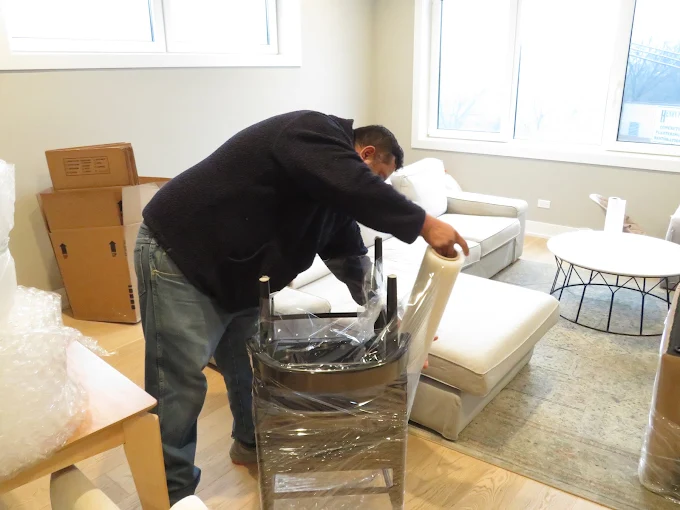
Set aside anything not going on the truck and mark it unmistakably. A corner of one room works, or a closed closet the crew is told to skip. Our crews walk the house with you beforehand and agree what goes and what stays, so your staging is what that conversation runs on. Booking professional packing services removes this step entirely, since our team stages as it packs.
Handle Documents and Small Valuables Separately
Passports, birth certificates, leases, closing paperwork, jewelry and prescriptions do not belong in the packing system at all. Put them in one bag that travels in your car. Pack that bag before you start on any room, so nothing valuable gets swept into a box during the final hour. That last hour is when almost every lost document goes missing.
Photograph anything valuable before it is wrapped. A minute per item gives you a dated record of condition, which is worth having whether or not you ever need it. Keep the bag with you from the moment you leave the old place until you are inside the new one. A bag set down near an open front door is the easiest thing in the house to lose.
Want the load to start on time? Just contact us, and we’ll walk through what should be staged before the crew arrives. You can also reach us at (773) 761-8330 or stop by 1040 N Cicero Ave, Chicago, IL 60651. We’re open Monday to Friday from 8:00 AM to 6:00 PM, and Saturday from 8:00 AM to 5:00 PM.
Related Topics: